
Myopia Treatment - (Short-Sightedness)
WHY CHOOSE US?
Myopia Treatment - I’m Short-Sighted, What Are My Options?
Myopia is the medical term for the eye condition commonly known as shortsightedness or nearsightedness. To correct this condition, there are a number of different myopia treatment options available including LASIK and Advanced PRK surgery.
Short Sight, Near Sight, Myopia
Overview Of Myopia
People with myopia see near objects clearly but their distance vision is blurred.
The blurring of vision associated with myopia is typically caused by the eyeball being too long or the cornea too steep. This causes the incoming light rays to focus in front of the retina instead of directly on it.
Signs of myopia are often noticed during school screenings or after parents notice that their children are having difficulty seeing street signs or the television. The condition can be inherited and usually starts at primary school age and stabilises in their late teens to early 20s. If you have shortsightedness, you may also experience tired eyes from overstraining, headaches, as well as squinting or frowning.
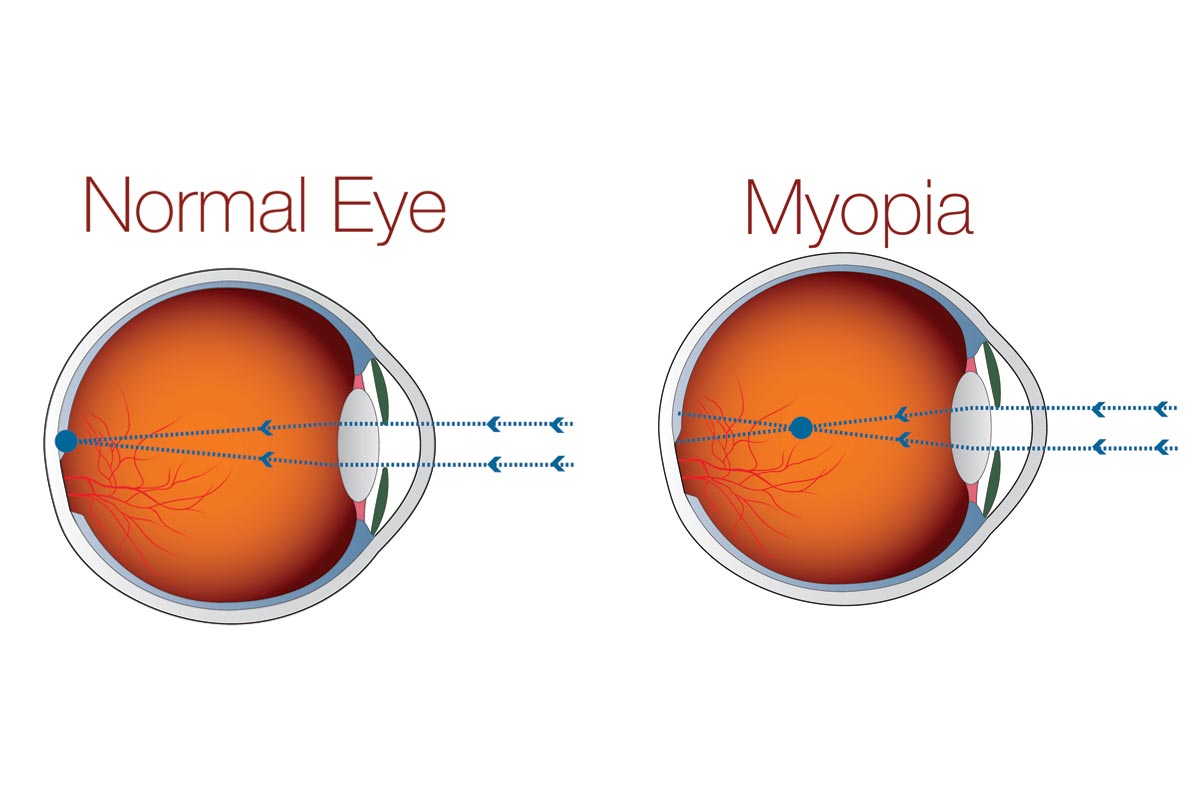
Short Sight, Near Sight, Myopia
Myopia Treatment
People are affected by myopia with different degrees of severity. Common treatments include glasses and contact lenses which work by refocusing the incoming light rays directly onto the retina. Laser eye surgery is the best shortsightedness cure that produces the same corrective result, but is permanent and gives the added benefit of being independent of glasses or contact lenses.
Laser Eye Surgery and Myopia Treatment
For those suffering from myopia and looking for a way to enjoy a life free from the hassle of glasses or contact lenses, laser eye surgery is the ideal solution.
When treated with an Excimer laser, the cornea is flattened to refocus the incoming light rays directly onto the retina, thus restoring clear and focused vision.
If you have short-sightedness we can almost certainly help. Find out more about treating your myopia with the latest in laser eye surgery by checking your suitability.

LASIK Treatment
LASIK (Laser-Assisted-In-Situ-Keratomileusis) eye surgery is a safe and painless procedure.
Over 80% of patients having laser eye surgery will undergo this treatment, and over 35 million people have enjoyed its results worldwide. The result of our LASIK eye surgery Melbourne wide is simply fantastic.

PRK Treatment
Prior to the development of LASIK, Photorefractive Keratectomy or PRK Surgery was the first astigmatism.It has undergone many advances and innovations since its introduction more than 20 years ago.
SILK Treatment
SILK™ (Smooth Incision Lenticular Keratomileusis) is a technologically advanced, keyhole laser vision correction procedure that may allow people to see the world free from glasses or contact lenses. With the SILK™ procedure most patients experience outstanding vision from day one with fast visual recovery – but results can vary from patient to patient.
Myopia surgery, recovery and costs
If you decide to have laser eye surgery treatment for your shortsightedness (myopia), you’ll typically return to work within 48 hours, noticing the improvement in your vision immediately.
If you’re concerned about affordability, find out more about our treatments and how to book your obligation free laser eye assessment now. You could be weeks away from spectacle and contact lens-free vision.
Treatments
How do they compare?
The total time for each procedure is between 15-20 minutes for both eyes, although the laser treatment itself lasts only seconds. Long-term results are equally as good with either method although good quality vision is reached quicker with LASIK. For this reason LASIK surgery is the preferred choice for correcting vision for most patients.
| PRK | LASIK | SILK |
|---|---|---|
| Prior to the laser treatment, the epithelial layer of the cornea is gently brushed away. | Prior to the laser treatment, a hinged flap is created on the cornea either with laser or a microkeratome. | Laser is used to create a lenticule within the cornea through a key-hole incision. |
| After the laser treatment, a bandage contact lens is placed onto the eye, while the epithelium grows back within a few days. | After the laser treatment, the flap is replaced, and the epithelium quickly repairs itself. | After the laser treatment, the lenticule is removed via the small key-hole incision to reshape the cornea. |
| Healing takes longer to achieve, compared to LASIK and SILK. | Healing is rapid, compared to PRK and SILK. | Healing is faster, compared to PRK. |
| Excellent vision is expected within a month although most patients can drive and return to work in a week. | Excellent vision is reached within a day, and most patients can return to work the following day. | Excellent vision is achieved within a week, and most patients can drive and return to work in less than a week. |
Where to find us
Clinic Locations
East Melbourne
Consultations & Laser Centre
160 Victoria Parade
East Melbourne VIC 3002